
What nursing staff reported
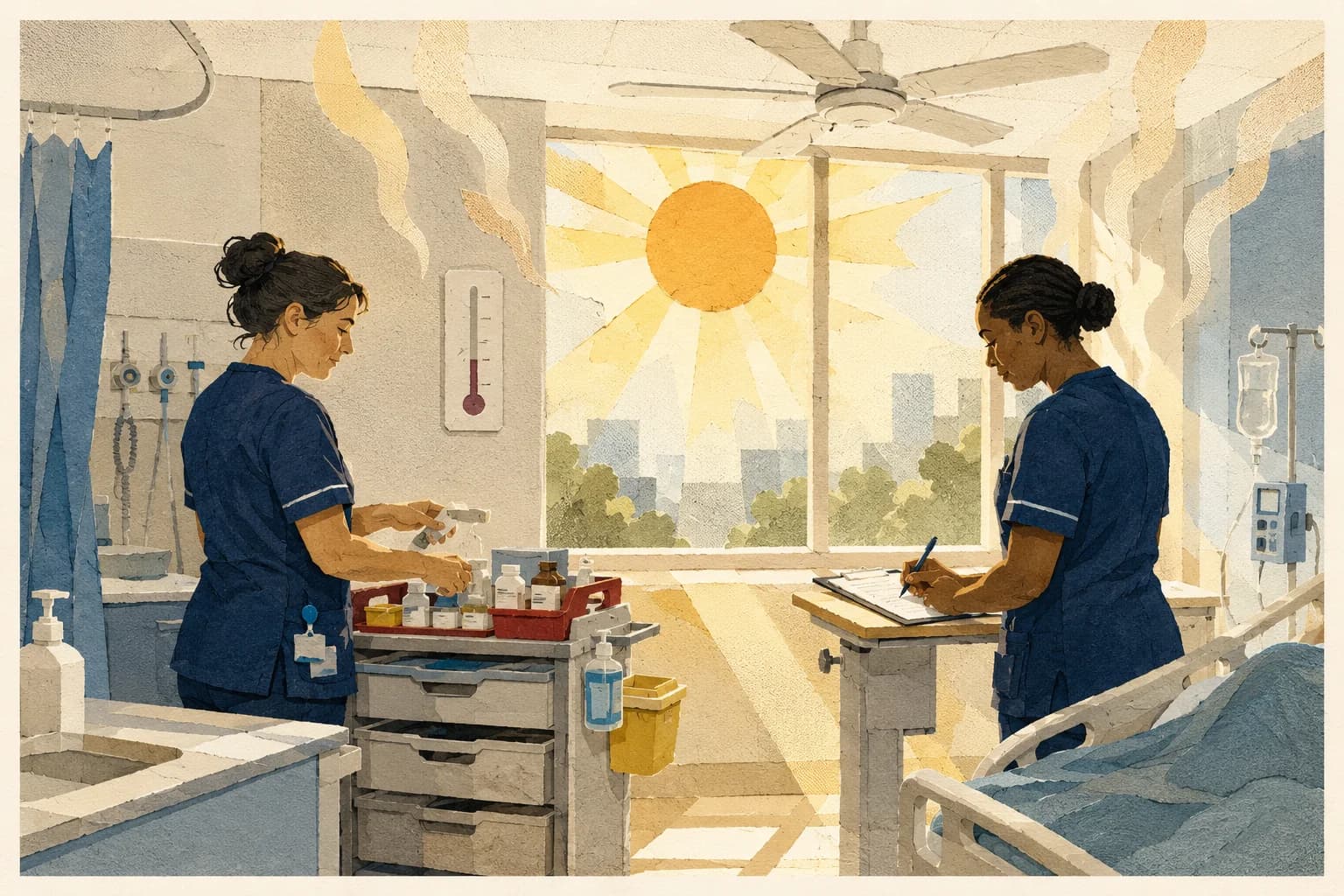
Calls to the Royal College of Nursing advice service during the August heatwave included accounts of staff collapsing at work, one worker having a heat related seizure and pregnant nursing staff working in areas above 30C. Other callers described wards and clinical rooms with little ventilation, no air conditioning and insufficient fans. The college also heard that requests to relax uniform rules or introduce practical cooling measures had been refused in some workplaces. These are serious reports because they describe harm occurring while care was being delivered, but the source matters. The RCN published a selection of contacts made to its service, not a national incident count or a representative survey of every NHS and social care employer.1
The reports went beyond personal discomfort. Callers told the college that patients were being cared for in rooms above 30C and that medicines, blood products or equipment had to be moved because conditions were unsuitable. Staff described trying to maintain hydration, infection prevention and patient observation while coping with heat themselves. A clinical area can therefore remain operational while becoming progressively harder to use safely. The account of an item being relocated does not prove that it had been damaged, and the RCN did not publish enough detail to assess individual incidents. It does show why temperature control must include storage, devices and care processes rather than focusing only on whether staff can tolerate a hot shift.1
Community nursing presents a different exposure pattern. The RCN said staff working away from fixed premises described hot cars, repeated travel and the effort of carrying heavy bags between visits. Those workers may have less access to cooled rest space, drinking water and immediate help than colleagues on a hospital site. A risk assessment built only around ward thermometers would miss that part of the workforce. Employers need to consider the whole working day, including travel, lone working, protective clothing and delays between visits. The relevant question is not whether a single location has crossed a universal number. It is whether the work, the worker and the environment combine to create a foreseeable risk that has not been controlled.1
The college used the calls to ask health and care employers for urgent heat proofing and for more consistent protection during extreme weather. Its intervention supplies direct testimony and identifies recurring practical problems, while its limits prevent a reliable estimate of prevalence. Neither scepticism nor alarmism is justified by a case series alone. A reasonable reading is that serious incidents were reported through a professional advice route and that the conditions described match hazards recognised in official workplace and heat health guidance. Services should investigate comparable risks locally, record incidents and near misses, and make their own data available so that future decisions are based on more than calls made during a crisis.1
What the law requires
There is no single maximum workplace temperature in Great Britain. That fact is sometimes presented as if employers have no enforceable responsibility once a thermometer rises, but the Health and Safety Executive says employers must provide a reasonable indoor working temperature and clean, fresh air. They must also assess risks and protect workers from harm. The absence of a statutory ceiling reflects the variety of workplaces, clothing and physical demands rather than an absence of duties. A laundry, operating theatre, community car and care home bedroom create different risks at the same measured temperature. The correct response is a suitable assessment followed by controls that address the actual work and the people exposed to it.3
Temperature is only one part of heat stress. Humidity, radiant heat, air movement, workload, personal protective equipment, shift length and access to breaks change how much heat a person accumulates. Health conditions, medicines, pregnancy and acclimatisation can also change individual vulnerability. An employer that records the room temperature but ignores heavy work, impermeable clothing or a worker who has become dizzy has not captured the full risk. HSE advice supports practical measures such as improving ventilation, shading windows, moving work away from heat, providing cooling and allowing workers to adjust clothing where it is safe. In a clinical environment, changes must also preserve infection prevention, dignity and the needs of patients whose temperature regulation may be impaired.3
Reasonable temperature does not mean that every room will feel identical or that all discomfort can be removed. It does mean that predictable seasonal heat cannot be dismissed as unavoidable. Employers can review estates before summer, identify rooms that retain heat, service ventilation, prepare portable equipment, test escalation contacts and agree how staff will report symptoms. Procurement and infection control teams should assess fans or cooling devices before an alert rather than forcing ward leaders to improvise. Occupational health input may be needed for individual adjustments. Where engineering controls cannot be installed immediately, temporary changes to work, breaks, staffing and use of space should be documented, communicated and reviewed as conditions change.3
Workers also need a reporting route that produces action. A policy asking staff to tell a manager is weak if nobody knows who can authorise a room move, additional break or equipment purchase. Local procedures should state how temperatures and symptoms are recorded, when estates and health and safety teams are contacted, and what requires senior escalation. They should protect staff from feeling that raising a concern will be treated as poor resilience. When someone collapses, develops neurological symptoms or becomes acutely unwell, the issue is no longer routine comfort management. The person needs appropriate clinical help, the incident needs recording, and the work area needs reassessment before colleagues are exposed to the same conditions.3
The heat health plan for services
The UK Health Security Agency action card for health and social care providers applies in England and treats heat preparation as a system responsibility. It covers hospitals, care homes, community services and care delivered in people’s own homes. The guidance is organised around seasonal preparation and escalating Heat Health Alerts rather than waiting until illness is reported. Providers are asked to identify high risk settings and people, review business continuity, ensure staff know heat illness signs and plan how to maintain safe staffing. That approach is important for nursing teams because demand can rise at the same time as staff capacity falls. Heat can worsen existing illness, disrupt sleep and increase the support needed by people who already depend on care.2
The action card advises services to monitor vulnerable rooms and identify cool areas, with attention to spaces that are difficult to keep below 26C. That figure is a planning and monitoring trigger in the guidance, not a universal legal limit for every workplace. It helps organisations find environments where patients or residents may be at greater risk and where further action is needed. Recording should be meaningful. A single reading from a cool corridor will not describe a sun facing bedroom in late afternoon. Services need a consistent method, times that capture peak heat and responsibility for reviewing the results. Where patients cannot move easily, the plan must bring cooling and observation to them rather than assume they can use a designated cool room.2
Hydration plans also require clinical judgement. Making drinks available is useful, but some people need encouragement, assistance or monitoring, while others have fluid restrictions or swallowing problems. Staff need enough time to offer appropriate fluids, document intake where indicated and notice deterioration. Medicines may increase vulnerability to heat or require particular storage conditions, but staff should not advise patients to stop prescribed treatment without clinical review. Pharmacy and medicines management teams should give clear instructions for storage excursions and replacement. The same preparation applies to nutrition, continence care, skin integrity and sleep. Heat response is safest when these needs remain part of ordinary care planning instead of becoming a separate checklist detached from the patient.2
Alert levels should change what happens on a shift. A service can pre-agree when non-essential activity moves, when extra welfare checks begin, how bank or agency staff receive a briefing, and who decides that a room should close. Community teams can map visits to people at greatest risk and ensure lone workers have water, rest opportunities and a contact if they become unwell. Care homes can plan safe visiting and communal cooling without isolating residents unnecessarily. The action card supports continuity planning, but the detail remains local. A plan that names responsible roles, resources and thresholds is more useful than a broad instruction to keep people cool.2
Why buildings and staffing matter together
Many health and care buildings were not designed for the temperatures now experienced during repeated hot periods. Large windows, limited shading, ageing ventilation and heat producing equipment can leave clinical rooms warmer overnight and allow heat to accumulate across several days. An estates solution may require capital work, but that does not remove the need for interim protection. Services can survey their hottest areas, publish the findings, prioritise shading and ventilation, and include summer performance in maintenance decisions. New construction and refurbishment should be tested for overheating in realistic use, including the number of people and devices in a room. Cooling that exists on a drawing but cannot maintain safe conditions during occupancy is not an adequate control.1, 2, 3
Staffing determines whether a heat plan can be carried out. Extra hydration rounds, observations, room moves and welfare breaks all consume time. If staffing is already below the planned level, adding heat precautions without changing capacity can force staff to choose between competing safety tasks. Managers should include heat in operational staffing discussions and identify work that can be reduced when alerts rise. This does not mean using a hot day as a general reason to cancel care. It means matching activity to risk and making explicit decisions about priorities. Staff who are new, temporary or moving between sites need the same information as permanent teams, including where cool rest areas are and how to report a concern.1, 2, 3
Continuity planning must also account for infrastructure failure. High electricity demand can affect cooling, refrigerators and digital systems, while transport disruption can delay staff and supplies. Services should know which clinical items require controlled temperatures, how long backup systems last and where stock can be moved safely. The RCN reports that some teams had already moved products or equipment. A planned relocation route, agreed with pharmacy, pathology or device specialists, reduces the chance of an improvised decision. Records should show what was exposed, for how long and who confirmed it remained suitable. That protects patients and prevents unnecessary disposal when conditions can be verified.1, 2, 3
Visible leadership matters because staff may normalise heat when every area is affected. Senior rounds can test whether local controls are working, ask about symptoms and resolve barriers that a ward or home cannot fix alone. They should include night staff and community workers, whose exposure may be less visible in daytime building checks. Boards and governing bodies can review incident patterns, temperature data, maintenance backlogs and staff feedback after the season. The purpose is not to create another performance score. It is to find repeated failures, fund durable controls and understand whether the organisation’s written plan changed conditions where care was actually delivered.1, 2, 3
What should happen after the heatwave
A post incident review should begin with evidence that services can collect. Useful records include room temperatures at consistent locations and times, staff and patient symptoms, equipment failures, cancelled or moved activity, requests for help and the time taken to respond. Occupational health and incident systems may hold different parts of the picture, so organisations need a way to review them together without identifying individuals unnecessarily. Staff surveys can add experience, but questions should distinguish between discomfort, symptoms, clinical harm and barriers to action. That produces a more accurate account than a single question asking whether a workplace was too hot.1, 2, 3
The review should separate controls that worked from those that were merely available. A fan stored on site is not a successful intervention if infection control advice prevented its use or no one could locate it. A cool room offers little protection if frail patients could not reach it. Uniform flexibility helps only when staff understand what is permitted and suitable alternatives are stocked. Each failure should have an owner, timescale and funding route. Quick changes can be completed before the next alert, while estates work may need a longer programme. Publishing a summary to staff closes the reporting loop and shows which concerns led to action.1, 2, 3
National bodies also need better comparable data. The RCN accounts demonstrate why staff testimony matters, yet advice line contacts cannot show the denominator, regional distribution or rate of harm. Consistent reporting categories for heat related incidents would help employers and policymakers identify settings with repeated problems and evaluate investment. Any national collection would need clear definitions and proportionate burden. It should not discourage urgent local reporting by making every event administratively complex. Existing incident and occupational health systems may be adapted before a new return is created. The aim is to make hidden exposure visible while preserving the narrative details that explain how a failure occurred.1, 2, 3
The immediate lesson from the August reports is narrower and more actionable than a claim that every NHS ward became unsafe. Nursing staff described serious effects in particular workplaces, official guidance recognises the hazards, and employers already hold duties that do not depend on a statutory maximum temperature. The test before the next hot period is whether services know their vulnerable rooms and workers, have controls that can be activated quickly, and give staff authority to escalate when those controls fail. Heat preparation belongs in patient safety, workforce and estates planning together. Treating it as temporary discomfort leaves each team to rediscover the same risks when temperatures rise again.1, 2, 3

Comments
Loading published comments
Preparing the comment form